Meet Lilith: The Desert Demon Fronting the Band at the End of the World
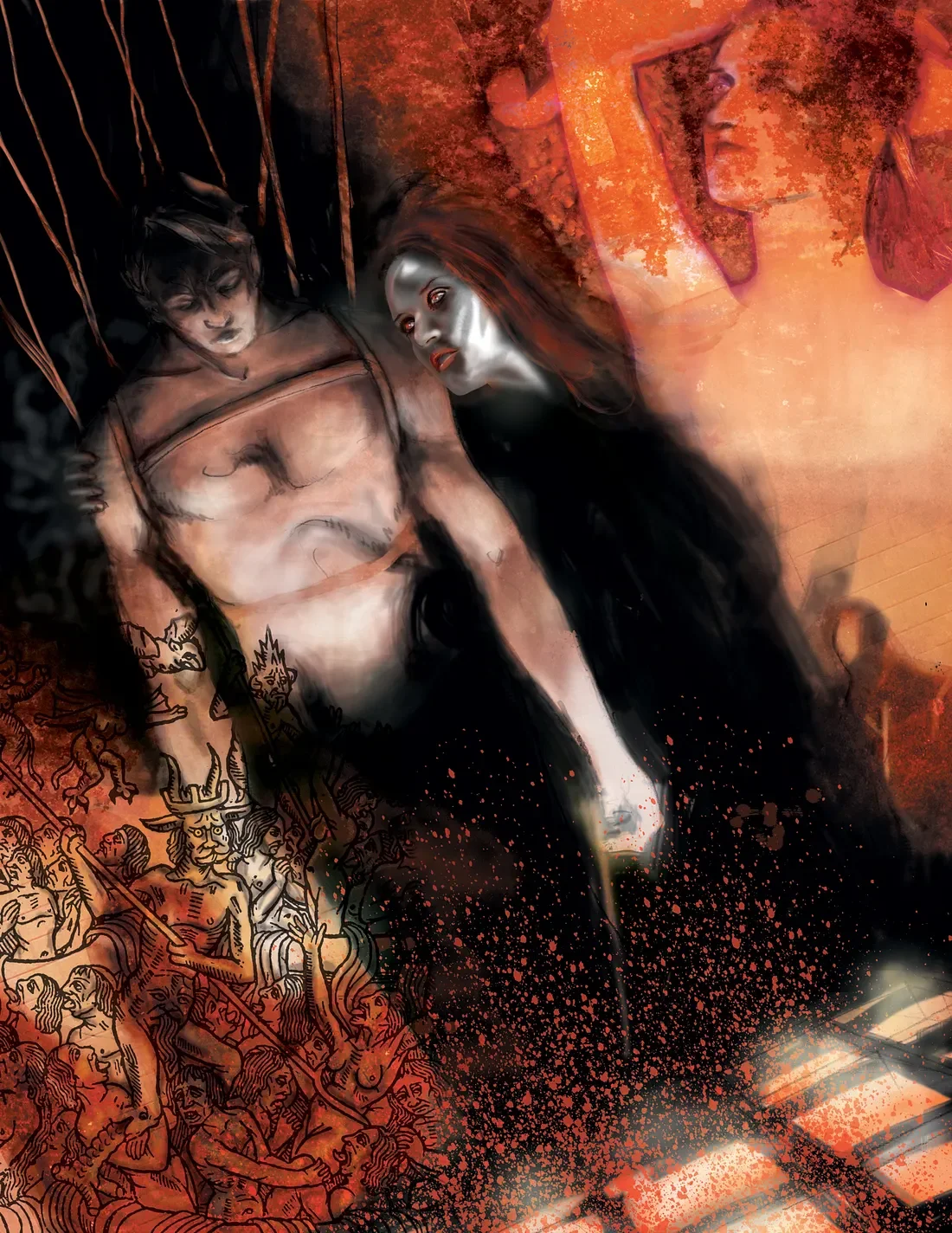
Art by Daniele Serra and James Curcio.
The Queen of the Flip Side
Lilith begins not as a Goddess, but as a demon, a malevolent force that you can hear when the wind howls in the desert, carrying with it the sharp sting of sand.
What follows is an attempt to clarify her motivations and portrayal throughout the Fallen Cycle, a transmedia series grounded in many years of research into history, myth, and symbol. This essay merges some elements of the personal, literary, mythic, and ethnographic, though not in any considerable depth.
These stories are now serialized in audio on the Fallen Cycle Mythos Fiction Podcast as well as in books available through Amazon and other online retailers. Nevertheless, here I can give some of the intention behind the allegory.
I will refer to her throughout as if she is an actual, individual entity. Of course, that’s only a literary convention. She has many guises, and like most symbols, their meaning is changed by location, and time, and even remains a subject of debate within those places and times.
She is a mirror; and it isn’t my point in this brief essay to follow all her myriad reflections. The mirror is itself symbolic of seductive illusions — most of all, the seductive illusion of our own self-awareness. Self-awareness is some variety of maintained illusion, a simulation run by the brain in which we are a being within a world or the illusion through which we encounter either symbols or the world is strictly representational, which is to say virtual, and decidedly not real.
In a sense, this makes all our experience suspect; what we consider “most” real is sometimes the least.
When we look in a mirror, it is only through our image in that mirror that we see ourselves, but exteriorized. Folklore of various sorts centers around this inversion — vampires being unable to cast a reflection in a mirror, the common so-called Primitive belief that cameras will capture our soul, the general power of the image to convey a sense of reality.
The very motive force of the mask depends on this illusion; mimesis is tantamount to her art. (I explore this at some length in Masks: Bowie and Artists of Artifice, Intellect Books, 2020.)
Consider also the transformation of guises as the purposes have changed. Devi, deva, and dæmon. How shall we distinguish them? The synthesis of these ideas is at the root of the Fallen Cycle: the distinction between demon and god is in the eye of the beholder.
It isn’t so much a matter of power as of function. A demon is that which is cast out, and divine at the same time. Cast out of the culture, cast out of ourselves, of our consciousness. It’s absolutely disastrous to think the demons howling in the desert are your friends. But she is playing at being rock star with the full force of her symbolic presence, knowing full well that cults of personality that shatter reality testing beyond a certain point can really only play out one way. Like Jim Jones or Heaven’s Gate.
The portrayal of Dionysus in René Girard’s Violence and the Sacred is very much in line with this. A Freudian at heart, he saw it as the revenge of the repressed. The Dionysus of Party At The World’s End is more akin to the philosopher-aesthete Bowie liked to play amongst the elite than to a god of “homicidal fury,” as Girard writes. There is also a great deal of Euripides’ play The Bacchae in this story, in fact, but we’ll need to cover that in depth another day.
Regardless, that fury does erupt around him all the time, and that has to do with his alchemy with Lilith. (I will deal with that in a subsequent essay for Dionysus, when I can steal the time.)
The First Eve and the Marriage
Lilith represents forces that are cast out of our social sphere, a force that must be banished to make domesticity possible, at least when conducted within the confines of the paradigm of marriage-as-ownership. From within the circle of that worldview, she would certainly look frightful. The first Eve, she is recognized for her defiant nature, another anti-patriarchal, anti-authoritative symbol. To this extent, at least, she has something in common with Dionysus. This is the form we encounter her in as her myth leaves Babylon with the Jewish exile.
Lilith often appears in a different form to men than to women. To women, especially within sexually restrictive cultures, we see more of the “devourer of children” aspect. To men, she appears as the seductress, the dark anima, the kind of girl that you don’t take home to mother. This can arouse some; in others the “devouring mother” aspect is invoked, and they shrink, terrified. But in either case she represents a direct threat to the established social order, especially the “estate”-order of marriage and monogamy. She is an enemy of stasis, of duty and restrictive societal bonds.
…Lilith the queen of the flip side the infernal moon and goddess mother of all demons and succubi with her lover Asmodai the hermaphroditic alignment now spawning offspring known as wise Baphomet made possible thanks to the blind serpent slithering through the mind…
On the one hand we have Lilith as a spirit of the desert, a creature that could slip into your house and devour your children. This is how she would be presented to women, a bogeyman to keep them in place. This fear tactic isn’t often articulated consciously; it is something that all the members of a cultural domain participate in unconsciously.
Simultaneously, there is this idea of her as the seductress, luring men away from their societal commitment to the “good wife” in her role as mother. This is an element which some superficially similar symbols, such as Kali, lack. Without needing to return to textual source, it’s easy enough to typify “that sort” of woman. She has the audacity to do what she wants, and it very well might not be what you, or the society wants. There is something impetuous and child-like about her, which can manifest as a resolute defiance when placed within the context of a system of rules.
Nowadays that might be called Oppositional Defiant. So long as she’s cast in the role of villain, this arouses the suspicion and fear of the wives of men, and their shameful observance to whichever force is the stronger.
In modern contexts, the threat posed to women is re-enforced by the ad and fashion industries’ efforts to increase competition and insecurity, as well as the conflict of the myths of domesticity, “slut shaming,” and so on. In a softer, more romanticized form, it is not surprising that Lilith has re-appeared as a potent symbol in bi-, lesbian, and polyamorous communities, especially amongst those who might have some derision towards “breeders.”
Despite how good liberation may sound to our ears, it isn’t a simple matter of good and bad. Her craft is more likely to lead to destruction than any kind of immediate synthesis. She’s the sort who might knock down your sandcastle just for the fun of it. This too she shares in common with Dionysus.
Not even Lucifer has such a defiant nature. Lucifer defies authority to follow his inner code. Lilith is considered the “dark feminine,” perhaps mostly because it is a frame we are unfamiliar with placing the feminine within. Though Jung framed the darkness and chaos of the feminine — goddesses or demons — as intrinsic to the state of the natural order, figures like Jordan Peterson seem unable to hide their own psychological insecurities in this regard. She is the willful protagonist, in the way a male would be in a male-dominated society, and this produces its own counterbalance.
Lilith and Kali: The Dagger and the Fire
This is one of the things that distinguish Lilith from a “dark mother” symbol like Kali. Kali may appear frightful from within the field of time, but as an agent of transformation, specifically within the context of sex and death, she is a synthesizer. She may be “dark,” but she remains a mother goddess. Alchemically, psychologically, synthesis is a process of union. To make way for that, there needs to be destruction. To accomplish this, Lilith divides, even seemingly without point.
Her culminating behavior in Party At The World’s End is likely to seem mad to anyone who doesn’t see this, and recognize the function of ritual.
She laughs at Crowley’s assumption that she’s just a cup waiting around for magicians to plunge their staves. She’s the dagger and the fire, and in that serves a purpose as important as union, in the right place and time. Perhaps synthesis is the ultimate result, and such destruction can lead to the birth of something new, something better. In this they are the same. But that is up to the individual. She certainly isn’t going to do it for you, or wait around to find out.
She appears in Party At The World’s End as Lola Rose Parsons, and claims she is the granddaughter of Jack Parsons. Her bandmates take her for an overnight success, but in the prologue we are given a sense that she has been fuck-initiating the entire eastern seaboard, breaking one person at a time in a way that turns some of them into perfect weapons for her purposes later in life.
When we first encounter her, we find a young woman who already believes she is the modern incarnation of Lilith, and mad or not, she is drawing on that reserve of confidence.
At the same time, she is putting on an act, a performance for herself as much as those around her, which ultimately creates a myth that far exceeds whatever her flesh and blood limits are.
In the chapter “Train ’Em Young,” she has led a number of would-be initiates to a hot tub with her, and reveals this, explaining,
Women told tales of me… I would steal the men away from them. I would devour their children. I was an abomination. I lived inside mirrors to seduce the vanity of nubile girls. Can you imagine?
Her appearance in Tales From When I Had A Face reveals more of her nature, as an apocalyptic goddess, worshiped in both hope and terror for her return…
Note: “Babalon” was a Crowleyian invention, his interpretation of the Whore of Babylon, with a revised spelling based on Qabbalistic numerology, or on his voracious appetite for intoxicants, depending on your interpretation of the man. In either event, these symbols are all incredibly similar to Lilith, but not identical.
If this topic interests you, delve into the Fallen Cycle face first.
Party At The World’s End (available now, and running in audio as Seasons 5 and 6 of the podcast) and Tales From When I Had A Face (out now, with its own audio adaptation across Seasons 1 through 4) both deal with her in some sense, the latter being quite likely the final installment in her story.